.png)
The 2025 Data Convergence Maturity Report Reveals How Fragmentation Is Slowing Security Teams
Why This Survey Matters Right Now
Security and IT teams are operating in a very different environment than they were even two years ago. AI-driven workflows are expanding quickly. Tool ecosystems continue to grow. Data volumes are accelerating. Yet teams are not scaling at the same pace.
The result is a widening gap between what organizations collect and what they actually understand.
Visibility gaps are no longer abstract technical challenges. They are showing up as missed risks, delayed decisions, audit fatigue, and real business disruption. Leaders are being asked to move faster, prove control effectiveness, and support the business with fewer people and tighter budgets, all while managing increasingly complex environments.
That pressure is exactly why SmarterD launched this benchmarking survey. The goal was not to restate familiar industry talking points, but to understand how organizations are truly operating today, where fragmentation is holding teams back, and what separates higher-maturity organizations from the rest as we head into 2026.
What the data shows is clear. Tools alone are not the problem, disconnected data is.
What We Set Out to Learn
Our benchmarking survey focused on one central question: How effectively are organizations turning security, IT, and compliance data into usable intelligence?
More specifically, the survey explored:
- How teams manage assets, risks, and compliance across growing tool ecosystems
- Where data convergence is actually happening and where it breaks down
- The operational impact of fragmented visibility on incidents, governance, and reporting
- How maturity differs across organization size, industry, and security posture
Participants represented a broad mix of mid-market and enterprise organizations across regulated and non-regulated industries. Respondents included CISOs, CIOs, CTOs, IT directors, infrastructure leaders, and security and compliance practitioners. Maturity levels ranged from early-stage programs to highly structured environments managing multiple frameworks.
What emerged was not a story of failure, but one of partial progress. Many organizations are doing the right things, but not in a connected way.
Key Finding #1: Visibility Gaps Are Driving Incident Numbers Up
Nearly 60% of respondents reported that recent security incidents were tied to gaps in visibility, not a lack of tooling or intent.
Traditional discovery methods are struggling to keep up with modern environments. Assets change faster than inventories update. Cloud resources spin up and down. Identities shift. Controls exist, but coverage is unclear. When data lives in separate systems, teams cannot see risk in time to act.
High-performing organizations stand apart here. They do not rely on periodic discovery or manual reconciliation. They operate from continuously updated, normalized data sets that connect assets, users, risks, and controls into a single operational view.
The difference is not effort, it’s architecture.
Key Finding #2: Tool Sprawl Is Making Governance Harder
The average organization in the survey reported using 11 or more security and IT tools. Each tool delivers value in isolation. Together, they often create friction.
Disconnected telemetry slows decision-making. Teams spend time reconciling alerts instead of resolving risk. Overlapping controls create duplicate work. Reporting becomes a manual exercise, especially when leadership or auditors ask cross-functional questions.
Governance suffers not because teams lack frameworks, but because the data behind those frameworks is scattered. When controls are evaluated separately across tools, confidence erodes.
More tools do not equal more control. Without convergence, they compound complexity and increase risk.
Key Finding #3: Automation Is Up, but Data Convergence Is Still Down
Automation adoption is strong. Most teams have automated workflows for alerting, evidence collection, and compliance tasks. Yet many of those workflows still operate inside silos.
This creates a gap between automated governance and intelligent governance.
Automation reduces effort, but it does not create understanding. Without shared context, teams still struggle to explain risk, prioritize remediation, or prove effectiveness. Over time, this leads to governance fatigue and burnout, not because teams are inefficient, but because they are constantly stitching together answers.
Intelligence requires convergence — data that is structured, normalized, and connected before automation is applied.
Key Finding #4: Framework Alignment Is Improving but Remains Fragmented
Adoption of frameworks such as ISO, SOC 2, and NIST continues to grow. That progress is encouraging. However, most organizations still manage each framework independently.
Controls are mapped multiple times. Evidence is collected repeatedly. Reporting is customized for each audit instead of derived from a shared control foundation.
The opportunity lies in cross-mapping and unified control intelligence. When controls are treated as shared operational assets rather than framework-specific checklists, teams reduce redundancy and increase confidence across audits, assessments, and internal reviews.
The Maturity Ladder: From Fragmented to Intelligent
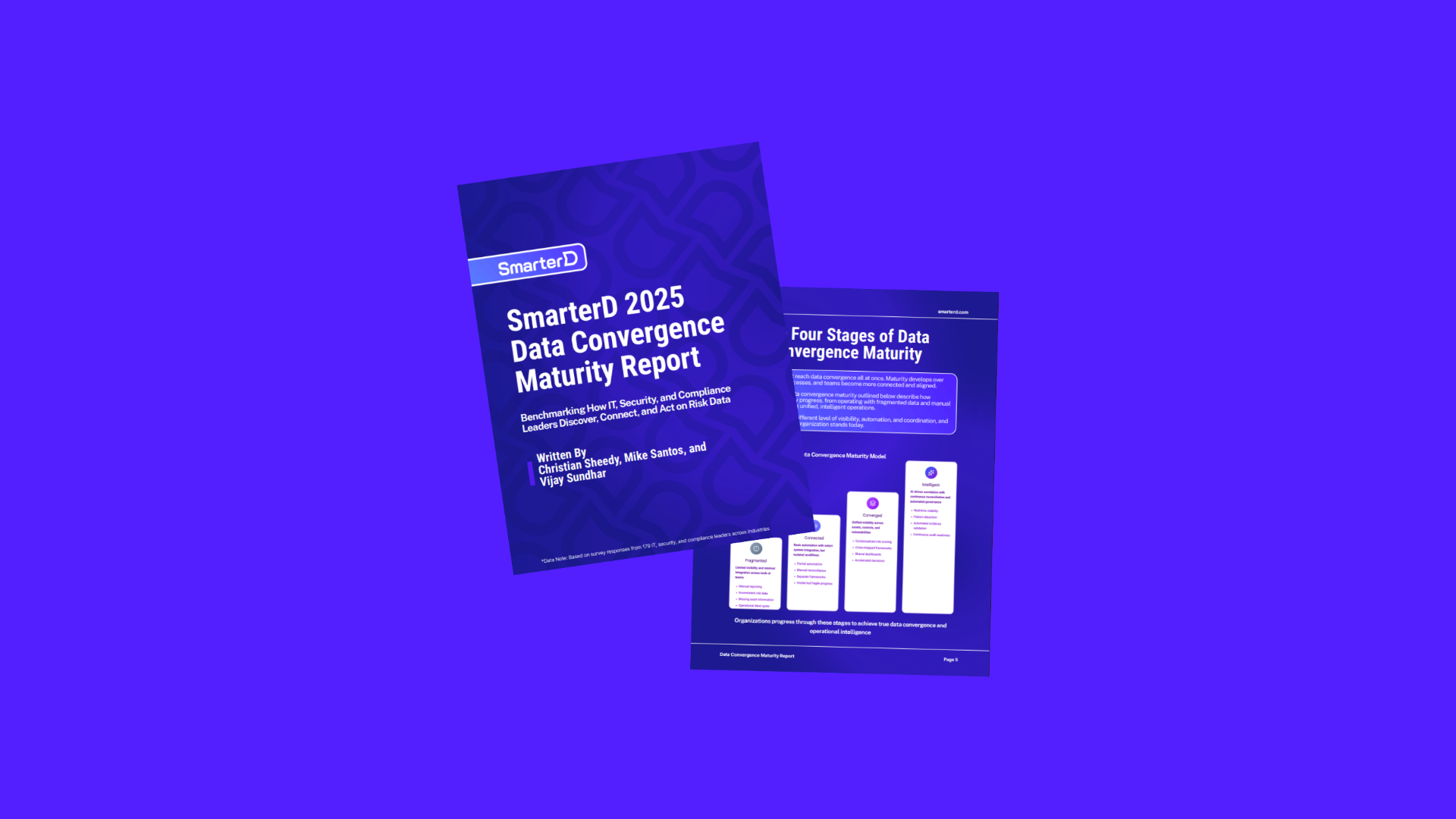
Survey responses clustered into four clear maturity tiers.
At the lowest level, organizations operate in a fragmented state. Tools are deployed, but data is disconnected and visibility is limited.
The next stage introduces basic integration. Teams gain partial visibility but still rely heavily on manual processes.
More mature organizations move into convergence. Data is normalized across systems, creating consistent views of assets, risk, and compliance.
At the highest tier, intelligence emerges. These organizations operate with real-time context, AI-ready data, and unified governance models that support faster, more confident decisions.
Progressing through these stages is not about adding tools; it’s about simplifying and strengthening the data layer that connects them.
What the Highest-Maturity Organizations Have in Common
High-maturity teams consistently share four traits:
- Connected context across IT, security, and compliance
- Data foundations designed for analytics and AI
- Unified governance models rather than framework silos
- Fewer tools, paired with clearer priorities
They spend less time reconciling information and more time acting on it.
What This Means for IT and Security Leaders Going Into 2026
The cost of inaction is becoming clearer. Fragmentation slows response, increases risk exposure, and drains already stretched teams.
As environments grow more complex, convergence and intelligent automation are shifting from optional to mandatory. Budgets, staffing models, and operating strategies are starting to reflect that shift.
Leaders who invest in unified data foundations now will be better positioned to scale securely, support AI initiatives, and adapt to future regulatory and business demands.
Download the Full Data Convergence Maturity -Report
The full SmarterD 2025 Data Convergence Maturity Report includes detailed findings, charts, maturity indicators, and actionable recommendations.
If you are looking to improve visibility, reduce complexity, and build a converged security and IT governance model, the data is there to guide the way.